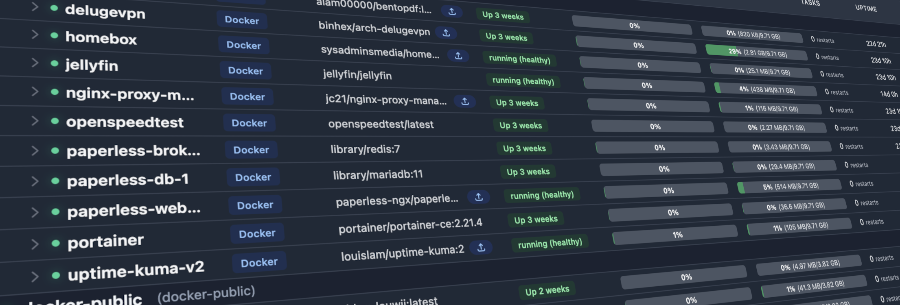
Having a cute homelab is cool, but part (most?) of the fun is doing things with it.
Everything I use/host at home is free. Some of the apps have paid versions with extra features, but I haven’t paid for anything. I’m a cheap bastard. Everything I’ve hosted so far is open-source, which I prefer over closed source. Lastly, almost all these apps are running in Docker. Docker containers are so easy to manage, and light, it’s the best way to go for self-hosting anything.
A quick warning, do your own research. I haven’t reviewed any of those particularly deeply. I based my judgement on history (how long that project has been maintained), Github starts (which can be bought, so technically they don’t mean much…), recommendations from other users (often on Reddit r/selfhosted or r/homelab). As of early 2026, AI slop is a major issue in the open-source community. A lot of new projects are created, built over a few days, with nice features and decent design. But who knows how well they will be maintained. Security issues are pretty common amongst AI-coded projects, code quality can be janky as well. Not saying all AI projects are crap, but it’s worth being careful.
If you’re looking for more, there’s the awesome self-hosted list.
Let’s dive in!
Click here to know more about my Homelab
Media: Jellyfin
All my media files are stored on my NAS. My Jellyfin server Docker container can access those files through a mounted drive via SMB share. Any file I add, Jellyfin parses it and adds it to the collection. Effortless, frictionless.
Alternatives:
- Plex (paid)
- Kodi
Monitoring
Pulse
I use Pulse to monitor my hardware, VMs and Docker containers. CPU, memory, network, disk space. Nothing crazy, it’s just what I need in a simple UI.
Alternatives:
- Prometheus & Grafana - I used these for a bit. They’re great, crap-ton of data available, crazy dashboard customization. But that’s way too much. I switched to Pulse which makes more sense for my usage.
- Netdata
- Beszel
Uptime Kuma
I use Uptime Kuma to monitor uptime of a few apps on my private network, and the public websites that I host at home.
Alternatives:
Smarthome: Home Assistant
Home Assistant is probably the most popular smart home/home automation tool out there. It’s very powerful and supports a ton of devices.
Server Management & Tools
Proxmox
My 2 servers run the Proxmox hypervisor. Great system for managing VMs and hosting a large variety of things.
Portainer
The majority of the applications and websites I host at home run as Docker containers. Portainer helps me manage them. It’s very easy to use and convenient.
Nginx Proxy Manager
NPM is a reverse proxy manager. If you have no idea what it does: it makes your locally hosted apps accessible through nice URLs. Instead of having to use the server IP + Docker container port, you can use custom URLs and domains.
All my local apps use a sub-domain of .lan.louwii.com. E.g. https://jellyfin.lan.louwii.com
Document Management: Paperless-ngx
Paperless-ngx is a document manager: you put in all your bills, receipts, contracts, into that one place, to then be able to find them more easily.
Alternatives:
Inventory & Organization System: Homebox
This is pretty niche, especially for home use. I use Homebox to keep track of all the crap I buy/own. Sometimes I do forget that I have this or that sitting in a closet somewhere. It’s also pretty handy for keeping track of purchase dates for warranties.
Various
BentoPDF
BentoPDF is a PDF toolkit that works 100% on the client side. It’s great for editing those pesky PDF files. It’s somewhat pointless to host it locally, since the public online version works great and is privacy friendly already. But I like collecting Docker containers.
OmniTools
OmniTools offers various digital tools for media, PDFs, text, date, datasets… Once again, this is pretty much just for my Docker collection.
OpenSpeedTest SpeedTest server
That tool is great for doing local speed testing from the browser. I use it to make sure my network is configured properly and network speed is what I expect it to be.
Speedtest Tracker
Another network tool that monitors the performance and uptime of your internet connection. Retired I ran this container for a few months to see how my internet connection was doing. Given how stable it was, and still is, I stopped that container.
What I’m looking into
I’m not done, and will probably be adding new apps sooner or later. Here are a few that I have in mind:
Immich
Immich is technically a photo and video management solution. It’s a great Google Photos & Apple Photos replacement.
Kavita (and other ebook managers)
I have an e-reader with some books and mangas living on my NAS. Having a nice interface to manage them would be nice, as my collection starts growing. Kavita is the one I’m leaning towards, but there are others.
GeoPulse
GeoPulse aggregates GPS data from different sources and allows to browse everything on maps, with timelines etc.
AdventureLog
AdventureLog is a fancy trip planner. I do go on roadtrips and move regularly, this would be great for planning, but also keeping track of places I’ve been to and good spots I found along the way.
Analytics
As I’m hosting a few sites, having ome analytics would be nice. But I’m not willing to have to setup a cookie banner to be GDPR compliant, which I would have to if using Google Analytics or other big analytics. There are a few privacy-friendly and GDPR compliant analytics solutions out there. My short list is Plausible Analytics, Umami and Rybbit. They all offer a self-hosted version.
Not had enough? Check out the other Homelab articles